This is an archive article published on July 5, 2024
The world’s oldest cave art is 51,200 years old: What a new study says
Although the samples were collected in 2017, they were not dated until earlier this year. The painting is more than 5,000 years older than the previous oldest cave art — it was a painting of a wild pig, which was discovered in 2020 in Leang Tedongnge, Indonesia.
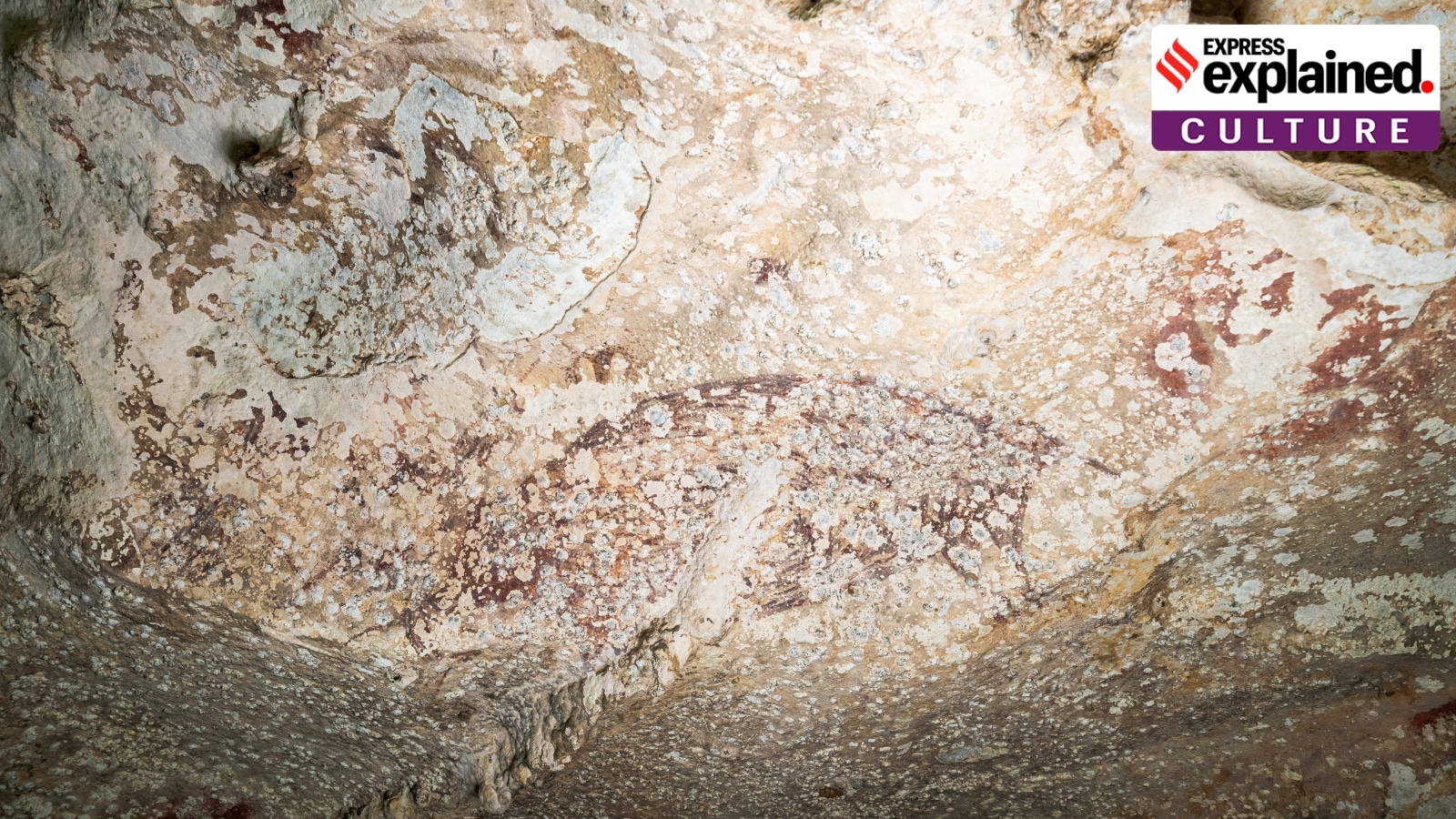
A painting created at least 51,200 years ago in the limestone cave of Leang Karampuang in the Maros-Pangkep region of the Indonesian island of Sulawesi portrays three human-like figures interacting with a wild pig, in this undated handout image. (Photo: Reuters)
Researchers have determined that the world’s oldest known figurative cave painting dates back 51,200 years by using a new dating technique, according to a recent study. Located in the Leang Karampuang cave on the Indonesian island of Sulawesi, the painting in red pigment shows a pig with its mouth partially open and three part-human, part-animal stick figures, or therianthrope.
The study, ‘Narrative cave art in Indonesia by 51,200 years ago’, was published in the journal Nature on Wednesday (July 3). It was carried out by a team of 23 researchers from Australia’s Griffith University, Southern Cross University and the Indonesian National Research and Innovation Agency.
Although the samples were collected in 2017, they were not dated until earlier this year. The painting is more than 5,000 years older than the previous oldest cave art — it was a painting of a wild pig, which was discovered in 2021 in Leang Tedongnge, Indonesia.
Here is a look at the painting, its significance, and what is the new dating technique.
What does the painting show?
“One figure seems to be holding an object near the pig’s throat. Another is directly above the pig’s head in an upside-down position with legs splayed out. The third figure is larger and grander in appearance than the others; it is holding an unidentified object and is possibly wearing an elaborate headdress… The manner in which these human-like figures are depicted in relation to the pig conveys a sense of dynamic action. Something is happening in this artwork – a story is being told,” according to an article, published by The Conversation, which has been written by the researchers involved in the study.
Why is the painting significant?
The researchers in the study wrote: “Our findings show that figurative portrayals of anthropomorphic figures and animals have a deeper origin in the history of modern human (Homo sapiens) image-making than recognised to date, as does their representation in composed scenes.”
Archaeological evidence shows that Neanderthals (considered closest ancient human relatives) began marking caves as early as 75,000 years ago, but these markings were typically non-figurative. The researcher further states: “On the basis of our dating work, it now seems that depictions of anthropomorphic figures (including therianthropes) interacting with animals appear in the Late Pleistocene cave art of Sulawesi at a frequency not seen elsewhere until tens of millennia later in Europe. This implies that a rich culture of storytelling developed at an early period in the long history of H. sapiens in this region — in particular, the use of scenic representation to tell visual stories about human-animal relationships.”
Nayanjot Lahiri, historian, archaeologist and professor of history at Ashoka University said, “It is an exciting discovery to be celebrated.”
What is the new dating technique?
The finding is based on dating using uranium series (U-series) analysis of calcite deposits overlying rock art in the limestone caves. Laser beams were used during the process and by comparing the ratio between the parent isotope (uranium) and the daughter isotope (thorium) researchers were able to date the paintings.
Using the same method, researchers also dated another hunting scene on a cave painting at Leang Bulu’ Sipong 4, earlier believed to be 43,900 years old. Their finding indicated that the painting is at least 4,000 years older than first estimated.
“This method enables us to more readily demonstrate the unambiguous relationship between the calcium carbonate material used for dating and the rock art pigment layer(s) to which it corresponds,” the researchers said in the study.
Story continues below this ad
Lahiri said that there are not many directly dated cave paintings. “In India, there is a lot of rock art in places like Madhya Pradesh, but you haven’t had this kind of dating.” She added, “This discovery underlines how important it is for the sciences to be involved in the work of archaeologists. The fact that we got such an early date allows us to ponder how it was conceived at that point in time, and so on.”
Vandana Kalra is an art critic and Deputy Associate Editor with The Indian Express. She has spent more than two decades chronicling arts, culture and everyday life, with modern and contemporary art at the heart of her practice.
With a sustained engagement in the arts and a deep understanding of India’s cultural ecosystem, she is regarded as a distinctive and authoritative voice in contemporary art journalism in India.
Vandana Kalra's career has unfolded in step with the shifting contours of India’s cultural landscape, from the rise of the Indian art market to the growing prominence of global biennales and fairs. Closely tracking its ebbs and surges, she reports from studios, galleries, museums and exhibition spaces and has covered major Indian and international art fairs, museum exhibitions and biennales, including the Venice Biennale, Kochi-Muziris Biennale, Documenta, Islamic Arts Biennale.
She has also been invited to cover landmark moments in modern Indian art, including SH Raza’s exhibition at the Centre Pompidou in Paris and the opening of the MF Husain Museum in Doha, reflecting her long engagement with the legacies of India’s modern masters.
Alongside her writing, she applies a keen editorial sensibility, shaping and editing art and cultural coverage into informed, cohesive narratives. Through incisive features, interviews and critical reviews, she brings clarity to complex artistic conversations, foregrounding questions of process, patronage, craft, identity and cultural memory.
The Global Art Circuit: She provides extensive coverage of major events like the Kochi-Muziris Biennale, Serendipity Arts Festival, and high-profile international auctions.
Artist Spotlights: She writes in-depth features on modern masters (like M.F. Husain) and contemporary performance artists (like Marina Abramović).
Art and Labor: A recurring theme in her writing is how art reflects the lives of the marginalized, including migrants, farmers, and labourers.
Recent Notable Articles (Late 2025)
Her recent portfolio is dominated by the coverage of the 2025 art season in India:
1. Kochi-Muziris Biennale & Serendipity Arts Festival
"At Serendipity Arts Festival, a 'Shark Tank' of sorts for art and crafts startups" (Dec 20, 2025): On how a new incubator is helping artisans pitch products to investors.
"Artist Birender Yadav's work gives voice to the migrant self" (Dec 17, 2025): A profile of an artist whose decade-long practice focuses on brick kiln workers.
"At Kochi-Muziris Biennale, a farmer’s son from Patiala uses his art to draw attention to Delhi’s polluted air" (Dec 16, 2025).
"Kochi Biennale showstopper Marina Abramović, a pioneer in performance art" (Dec 7, 2025): An interview with the world-renowned artist on the power of reinvention.
2. M.F. Husain & Modernism
"Inside the new MF Husain Museum in Qatar" (Nov 29, 2025): A three-part series on the opening of Lawh Wa Qalam in Doha, exploring how a 2008 sketch became the architectural core of the museum.
"Doha opens Lawh Wa Qalam: Celebrating the modernist's global legacy" (Nov 29, 2025).
3. Art Market & Records
"Frida Kahlo sets record for the most expensive work by a female artist" (Nov 21, 2025): On Kahlo's canvas The Dream (The Bed) selling for $54.7 million.
"All you need to know about Klimt’s canvas that is now the most expensive modern artwork" (Nov 19, 2025).
"What’s special about a $12.1 million gold toilet?" (Nov 19, 2025): A quirky look at a flushable 18-karat gold artwork.
4. Art Education & History
"Art as play: How process-driven activities are changing the way children learn art in India" (Nov 23, 2025).
"A glimpse of Goa's layered history at Serendipity Arts Festival" (Dec 9, 2025): Exploring historical landmarks as venues for contemporary art.
Signature Beats
Vandana is known for her investigative approach to the art economy, having recently written about "Who funds the Kochi-Muziris Biennale?" (Dec 11, 2025), detailing the role of "Platinum Benefactors." She also explores the spiritual and geometric aspects of art, as seen in her retrospective on artist Akkitham Narayanan and the history of the Cholamandal Artists' Village (Nov 22, 2025). ... Read More


 4 min read